Claude for Manufacturing is here. Here's where Ceptron fits.
Anthropic just gave plants an AI that handles the paperwork. Ceptron gives that AI a working model of the plant itself.
The short version
- Claude for Manufacturing is a language and workflow layer: quotes, quality reports, breakdown write-ups, the morning production report.
- Ceptron is a physics and cause-and-effect layer: why the process is drifting, what breaks next, and what happens if you change it.
- They stack. Claude does the writing and the routing; Ceptron supplies the answers that can’t be found in documents.
What Anthropic announced
On November 12, 2026, Anthropic launched Claude for Manufacturing, a plugin with skills for work that runs from pricing a new job to diagnosing a stopped machine. It ships with 17 skills and four connectors: Autodesk Fusion, Infor, Microsoft 365 and Oracle NetSuite. The skills cover six kinds of work:
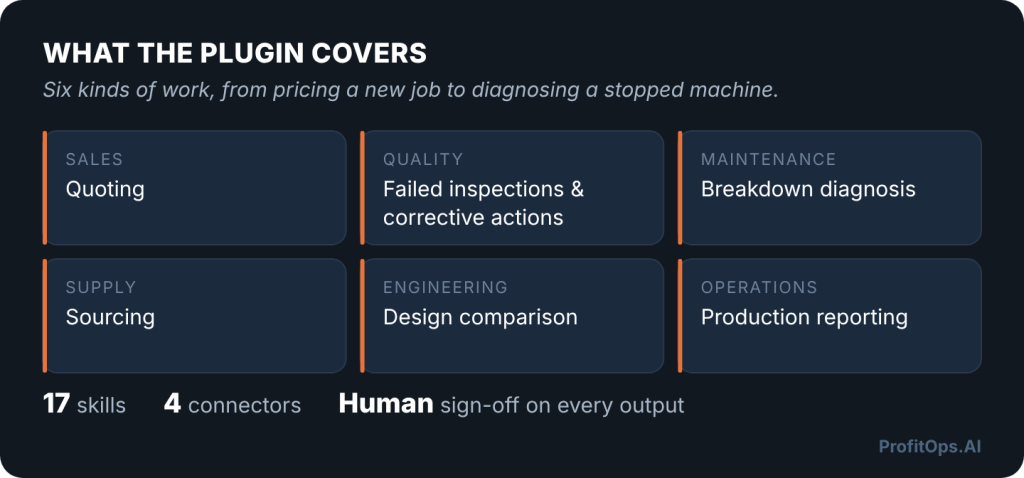
The problem it targets is real. Anthropic cites a 2025 Manufacturing Leadership Council survey in which 79% of manufacturers said they still enter data by hand. Two design choices stand out. Every skill ends with a person reviewing and approving the work, and Anthropic says plainly that the plugin does not operate equipment.
The gap, in plain terms
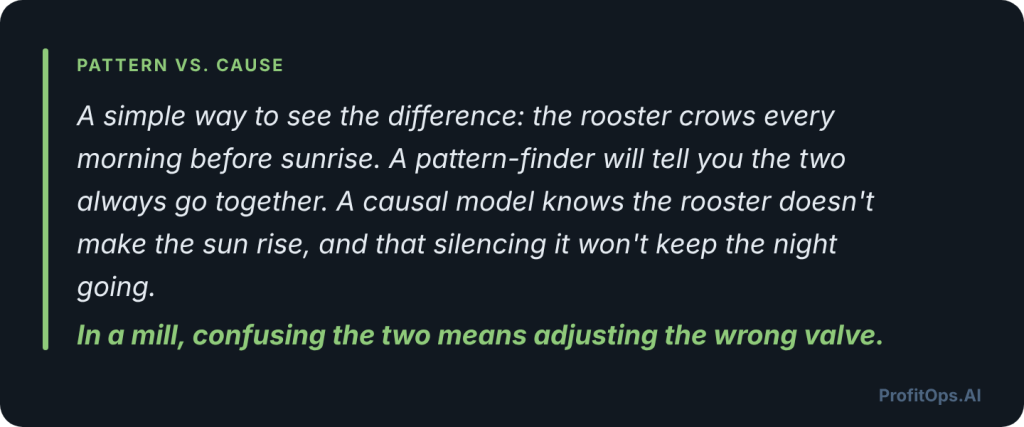
Look at what the plugin does when something goes wrong. For a stopped machine, Claude reads the sensor export, the repair notes, photos and the manual, then ranks the likely causes for a technician to check. Its root-cause skill runs pattern checks in code: control-chart drift, clustering by lot, shift or machine, and correlation with maintenance events.
That is careful, useful work. But it is pattern-finding after the fact. It doesn’t tell you which variable actually caused the problem, and it doesn’t warn you before it happens. The announcement describes no causal-analysis method, and sensor data arrives only as exported files, with no live historian feed.
How the two layers stack
Think of a plant’s AI as a building with four floors. Claude for Manufacturing fills one floor. Ceptron fills the one beneath it.
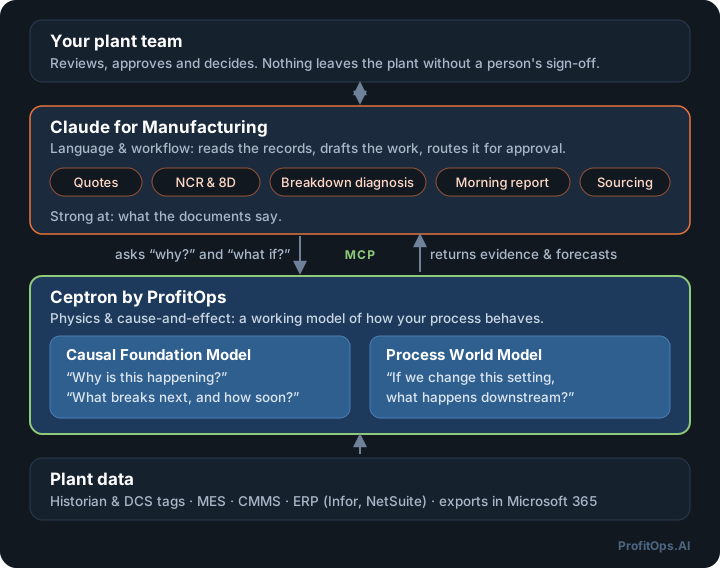
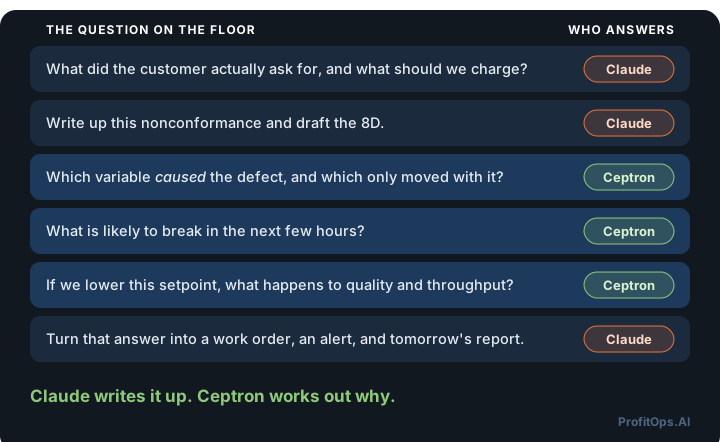
Who answers which question
Here is the difference on a paper machine, where an unplanned sheet break stops production.
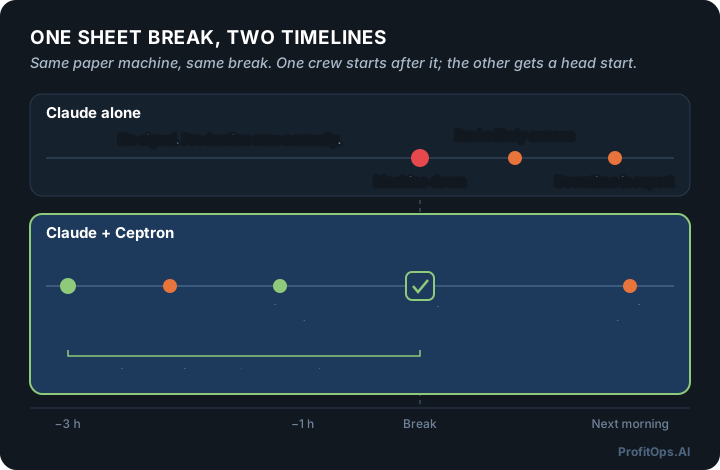
Green = Ceptron, orange = Claude, red = the machine going down. Without a causal model, the work starts after the break. With one, the crew gets a head start. The 176-minute figure is the median lead time from Ceptron’s production deployment described below; lead time varies from event to event.
Why we’re confident in that layer
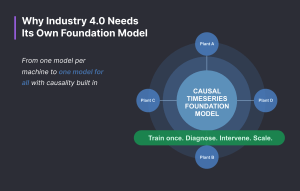
Ceptron’s Causal Foundation Model is built on TCPFN, a 21.6-million-parameter model that works zero-shot, meaning it doesn’t need to be retrained for each new plant. Deployed at a large North American integrated paper mill, it produced these results:
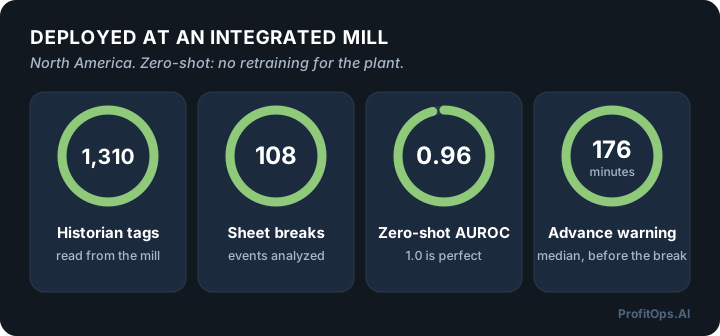
AUROC measures how well a model separates real warnings from false alarms. 0.5 is a coin flip; 1.0 is perfect.
What this means for ProfitOps
1. The market just got validated.
One of the world’s leading AI labs now has a product aimed at the plant floor. Buyers will spend less time asking whether AI belongs in operations and more time asking which AI does which job.
2. The paperwork layer is becoming standard. The model of the plant is not.
Reading records and drafting reports is now built into Claude. What sets a vendor apart is a model that understands the process: its causes, its physics, and its likely next failure. That is what Ceptron is.
3. Ceptron plugs in as the “why” and “what if” behind Claude’s skills.
It already runs as an MCP tool server for causal analysis, discovery, effect estimation and intervention ranking. Three natural pairings: causal evidence inside the breakdown-diagnosis and root-cause/8D skills, an early-warning section in the morning production report, and Process World Model what-ifs feeding design and setpoint trade-offs.
Our product principle hasn’t changed: the model is the brain, and the product is that brain delivered as always-on digital workers. Claude for Manufacturing gives those workers a capable colleague to hand the paperwork to.
Running Claude for Manufacturing, or about to?
We’ll show you Ceptron on your own historian data, wired into your Claude workflows. Write to hello@profitops.ai or visit ceptron.ai. The Ceptron causal discovery model is also open on Hugging Face.
Conclusion
Claude for Manufacturing takes the paperwork off the plant floor: quotes, 8Ds, breakdown write-ups and the morning report. But documents can only tell you what happened. Ceptron tells you why it happened, what’s likely to break next and what will change if you adjust a setting. Put the two together and your team gets warnings before the break, not just reports after it. Claude writes it up; Ceptron works out why.
Ready to transform the way you solve business challenges?
ProfitOps doesn’t just flag what will fail. It finds the root cause, recommends the intervention, and gets smarter with every plant you add so your operations outlast the experts who built them.

Shravan Talupula
Founder, ProfitOps